
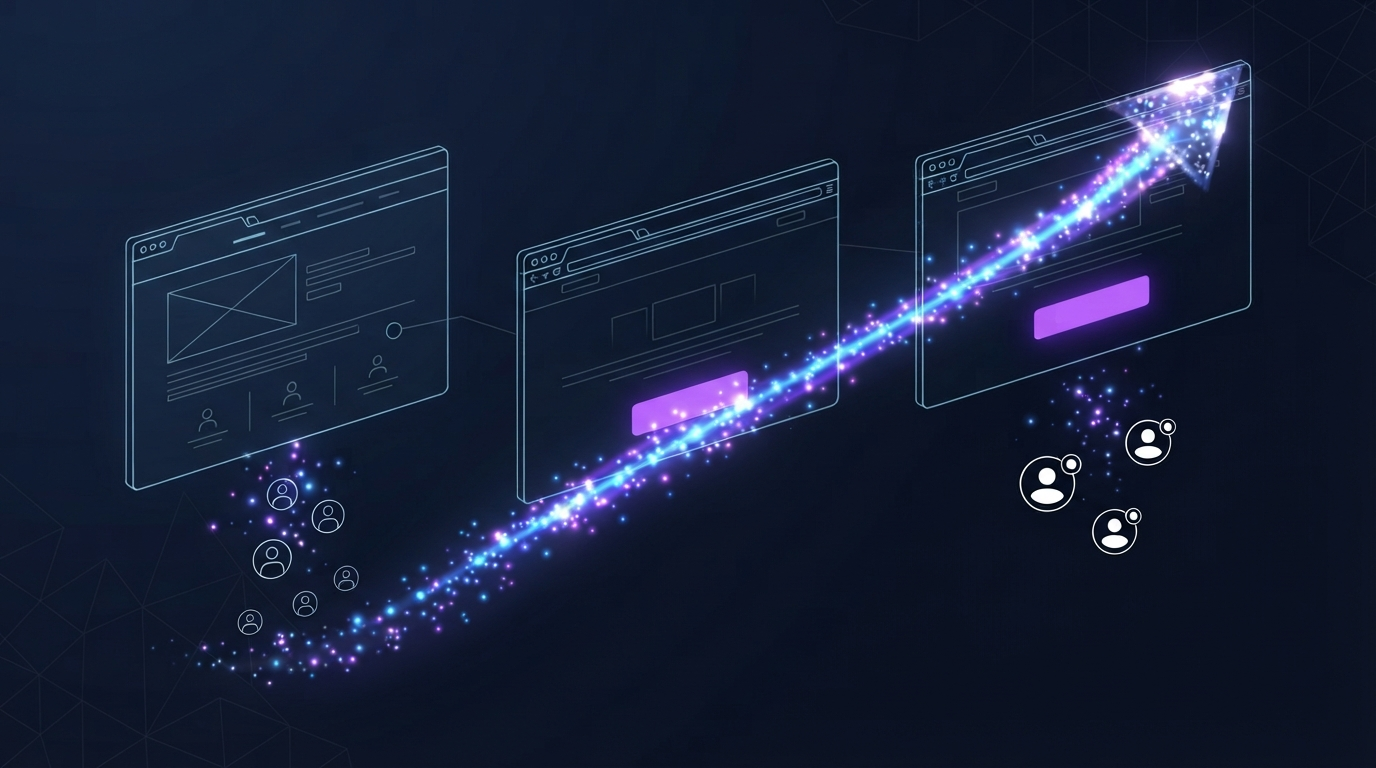
Most SaaS companies obsess over traffic. It is the wrong obsession. A hundred thousand visitors who bounce are worth less than two thousand who sign up, activate, and stay.
Turning visitors into users is a full-funnel system — positioning, page experience, signup flow, onboarding, and lifecycle working as one continuous journey. At Umami Digital Solutions, that system is built by developers and marketers together, because conversion lives in the product as much as the landing page. Here is how to build it.
Start with positioning: conversion begins before the click
Visitors decide in seconds whether your product is for them. Weak conversion is often weak clarity, not weak design.
Sharpen positioning by answering:
- Who is this for? Name the segment and use case in the headline. “Project management for everyone” converts worse than “Sprint planning for remote dev teams.”
- What changes for them? Describe the outcome, not the feature list.
- Why believe you? Evidence near the CTA — customer counts, logos, specific results.
This is where marketing data should feed the product team: search queries and sales objections reveal the exact language your best customers use. We cover the mechanics in why product development and marketing should work together.
Make the landing page a filter, not a brochure
A high-converting SaaS landing page does two jobs: convince best-fit visitors and repel everyone else cheaply.
Practical improvements that consistently move conversion rates:
- One primary action per page. Competing CTAs split attention and clicks.
- Speed as a conversion feature. Page load time directly correlates with signup rate; Core Web Vitals work is conversion work.
- Specific over clever. Concrete screenshots, real numbers, and named use cases beat abstract copy.
- Friction audit. Every form field, required field, and forced step costs a percentage of conversions. Remove or defer wherever possible.
Engineer the signup flow like a product surface
The signup flow is the most measurable, most improvable three minutes in your entire business. Treat it accordingly:
- Minimise fields. Ask only what you need now; collect the rest progressively after activation.
- Reduce decision fatigue. Unclear pricing tiers and forced choices at signup suppress conversion. A sensible default beats a questionnaire.
- Remove dead ends. Every error state, failed verification, and blank screen needs a recovery path.
- Instrument everything. Signup started, completed, abandoned — with the step where abandonment happened. Without this data you are guessing.
These are engineering changes. No marketing tool can ship them — which is why growth engineering matters for conversion.
Activation: the conversion that actually counts
A signup is a promise; activation is delivery. Define your activation event — the first action that predicts long-term retention — then engineer the first session around reaching it:
- Pre-load context. Sample data or templates so users see value before doing work.
- Guided first run. Checklists, tooltips, and progress indicators tied to the activation event, not a generic product tour.
- Time-boxed lifecycle messaging. Email and in-app sequences triggered by behaviour — “created a workspace but no project yet” — within the first 72 hours.
- Measure time-to-value and treat every day of delay as a conversion bug.
Weak activation is one of the 5 SaaS growth challenges that can slow your business — and the most fixable.
Run the whole journey as an experiment programme
No single change transforms conversion. Compounding wins do. Structure the work as continuous experiments:
- Form hypotheses from data: session recordings, funnel drop-offs, heatmaps, support tickets.
- Ship variations behind A/B tests — copy, flows, pricing presentation, onboarding steps.
- Review results with the whole team and scale the winners permanently.
A 15% lift at each of four stages compounds into nearly double the activated users from the same traffic — with zero additional acquisition spend.
The bottom line
Turning visitors into users is not a landing-page trick. It is a connected system: clear positioning, fast honest pages, an engineered signup flow, behaviour-triggered activation, and continuous experimentation.
Want every stage owned by one team that can ship the fix the moment the data shows the problem? Talk to us — let’s turn your traffic into growth.
Next article
Building a SaaS Growth Strategy Around Real Customer Needs